
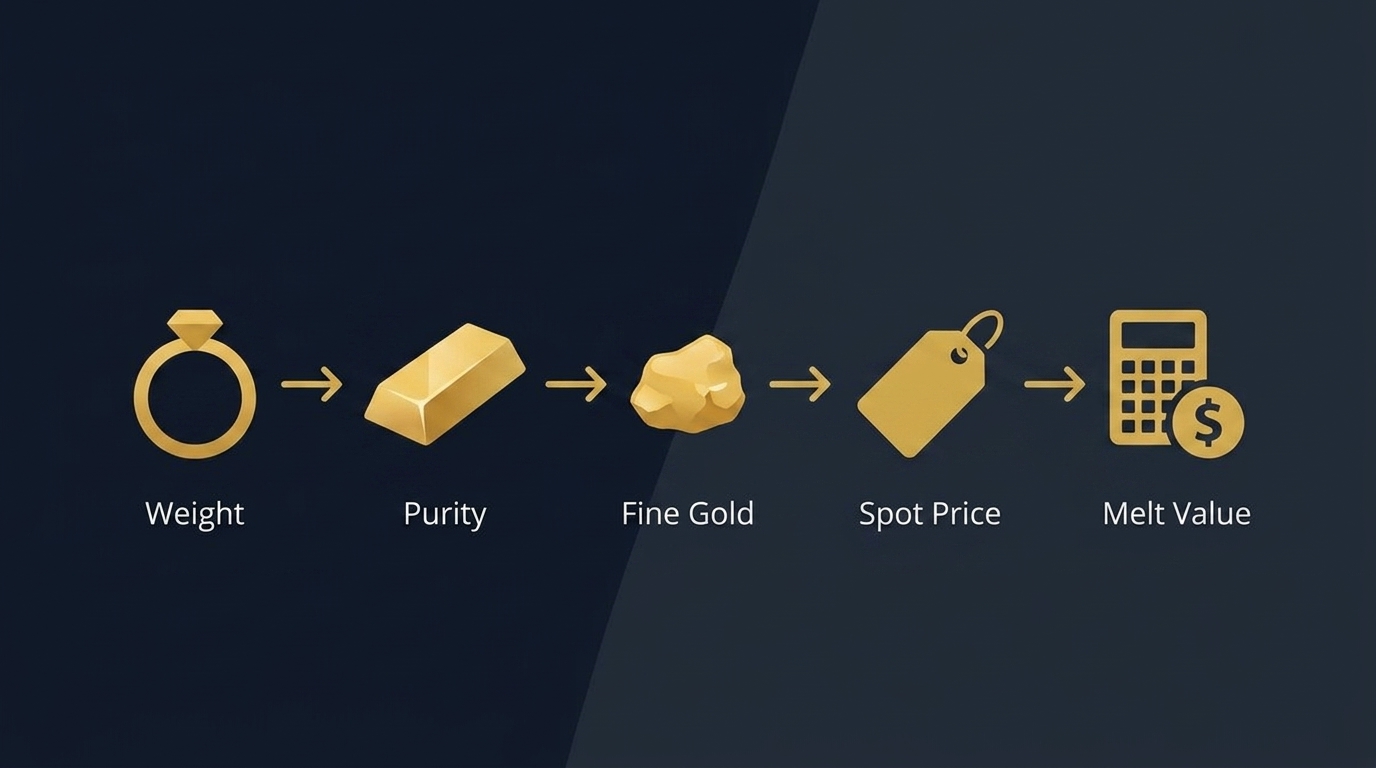
Calculate scrap gold value by converting the item weight into a consistent unit, multiplying by gold purity to find fine-gold weight, and multiplying fine-gold weight by the current spot price in the same unit. The result is a theoretical melt value — not a guaranteed buyer offer. Buyer payout ratios and separately itemized fees can then be applied to estimate net cash. Use our Scrap Gold Calculator for an instant calculation with live spot prices.
This guide walks through each step of the scrap gold value formula, explains where buyer payout diverges from melt value, and covers adjustments for jewelry with non-gold components and mixed-karat lots.
Scrap Gold Value Formula: The Basic Method
The full calculation chain follows this sequence:
Weight → Purity → Fine-Gold Weight → Spot Price → Melt Value → Payout → Fees → Net Cash
In formula form:
Fine-Gold Weight = Gold-Bearing Weight × Purity Decimal
Theoretical Melt Value = Fine-Gold Weight × Current Spot Price Per Matching Weight Unit
Estimated Payout Before Fees = Theoretical Melt Value × Payout Ratio
Estimated Net Cash = Estimated Payout Before Fees − Separately Itemized Fees
Each variable must use compatible units. If fine-gold weight is in grams, the spot price must be per gram. If fine-gold weight is in troy ounces (oz t), the spot price must be per troy ounce.
Step 1: Use the Correct Gold Weight
Weigh the gold item using a scale precise to at least 0.01 grams (g). The precious-metal industry uses three common weight units:
| Unit | Abbreviation | Relationship |
|---|---|---|
| Gram | g | Base metric unit |
| Pennyweight | dwt | 1 dwt = 1.55517384 g |
| Troy ounce | oz t | 1 oz t = 31.1034768 g = 20 dwt |
A troy ounce is not the same as a standard (avoirdupois) ounce used for everyday items. One avoirdupois ounce equals approximately 28.3495 g, while one troy ounce equals 31.1035 g. Confusing the two introduces a calculation error of roughly 10%. For a closer look at per-gram values, see Gold Value Per Gram.
Record the weight in one unit and keep that unit consistent through every remaining step.
Step 2: Convert Karat or Fineness to Purity
Gold purity is expressed using two related but not identical systems.
Karat (K) divides pure gold into 24 parts:
Purity Decimal = Karat ÷ 24
Fineness (millesimal) expresses gold content in parts per thousand (‰):
Purity Decimal = Fineness ÷ 1000
Karat and fineness values are closely associated but not always mathematically identical. For example, 14K gold has a karat fraction of 14 ÷ 24 ≈ 0.58333 (58.333%), while a 585 fineness stamp represents 58.5%. The difference is small, but the two should not be treated as interchangeable exact values. Similarly, 22K gold has a karat fraction of 22 ÷ 24 ≈ 0.91667 (91.667%), while 916 fineness represents 91.6%.
| Karat | Exact Karat Fraction | Exact Karat % | Common Fineness Stamp | Fineness % |
|---|---|---|---|---|
| 10K | 10/24 | 41.667% | 417 | 41.700% |
| 14K | 14/24 | 58.333% | 585 | 58.500% |
| 18K | 18/24 | 75.000% | 750 | 75.000% |
| 22K | 22/24 | 91.667% | 916 | 91.600% |
| 24K | 24/24 | 100.000% | 999 | 99.900% |
Mathematically, 24/24 equals 100.0% pure gold. In practical bullion trading and jewelry stamping, 999 fineness (99.9% fine gold) is the standard commercial mark because absolute 100% chemical purity is not attainable at industrial scale. For calculations on this website, the 24K calculator preset uses 0.999 (99.9% fine gold) by stated practical convention.
If a hallmark is difficult to read or absent, a hallmark interpretation tool can help identify the marking. A professional assay provides the most accurate purity measurement.
Step 3: Calculate Fine-Gold Weight
Fine-gold weight is the actual mass of pure gold inside the item:
Fine-Gold Weight = Gold-Bearing Weight × Purity Decimal
Example: 20 g of 14K gold contains approximately:
20 g × (14 ÷ 24) = 20 × 0.58333 ≈ 11.6667 g fine gold
The 11.6667 g represents the pure gold content available for valuation. The remaining 8.3333 g is alloy metal — typically silver, copper, zinc, or nickel — and carries no meaningful value in a standard scrap-gold transaction.
Step 4: Apply the Current Spot Price
The gold spot price is a per-unit market price for pure gold, quoted continuously during trading hours. Spot prices are most commonly quoted per troy ounce but can be converted to per-gram or per-pennyweight (dwt) rates.
The critical rule: the spot-price unit must match the fine-gold weight unit. If fine-gold weight is in grams, use the spot price per gram. If fine-gold weight is in troy ounces, use the spot price per troy ounce.
To convert a per-troy-ounce spot price to per gram:
Spot Price Per Gram = Spot Price Per Troy Ounce ÷ 31.1034768
Spot prices change throughout the trading day. Using a stale price can produce inaccurate results. Check live gold rates for current market pricing.
Step 5: Calculate Theoretical Melt Value
Multiply fine-gold weight by the matching spot price:
Theoretical Melt Value = Fine-Gold Weight × Spot Price Per Matching Unit
Example (hypothetical price): If fine-gold weight is 11.6667 g and the hypothetical spot price is $75.00 per gram:
11.6667 g × $75.00/g = $875.00 (hypothetical)
This $875.00 is the theoretical melt value — the calculated worth of the pure gold content at a hypothetical market price. The actual spot price at the time of a real transaction will differ from this example.
Theoretical melt value is not a guaranteed cash offer. A buyer’s actual payment depends on additional commercial factors covered in the next step.
Step 6: Estimate Buyer Payout and Net Cash
A buyer offer is typically lower than theoretical melt value. The difference accounts for the buyer’s assay and refining process, operational costs, market risk, and profit margin.
The relationship between melt value and a buyer’s payment involves two separate adjustments:
Payout ratio — the percentage of melt value a buyer offers before separately itemized fees:
Estimated Payout Before Fees = Theoretical Melt Value × Payout Ratio
Separately itemized fees — charges such as assay, refining, shipping, or processing fees, deducted individually:
Estimated Net Cash = Estimated Payout Before Fees − Separately Itemized Fees
Some buyers embed all costs into a single payout ratio with no separate fee line items. Others quote a higher payout ratio but charge separate fees. Comparing offers requires understanding whether fees are included in the ratio or itemized separately. For current market pricing and payout context, see Live Rates & Payout.
Theoretical melt value is not a guaranteed buyer offer. A buyer’s payment depends on the buyer’s payout terms, the accuracy of the assay, refining costs, current market conditions, and the specific item.
How to Calculate Jewelry With Stones or Non-Gold Parts
Jewelry often contains stones, clasps, springs, solder, or settings made from non-gold materials. These components add to the gross weight on a scale but do not contribute gold value.
Estimated Gold-Bearing Weight = Gross Jewelry Weight − Known Non-Gold Weight
Subtract the weight of identifiable non-gold parts before applying the purity factor. If stones or components cannot be removed and weighed separately, estimate conservatively — the gold-bearing weight will be lower than the gross weight displayed on the scale.
Keep gemstone carat (ct), a unit of gemstone mass, distinct from gold karat (K), a unit of gold purity. The two are unrelated despite the similar spelling.
For a focused calculation tool, see Gold Jewelry Value Calculator.
How to Calculate Mixed-Karat Gold
When a lot contains items of different purities, calculate each purity group separately and then add the resulting melt values. Do not average the karat values across items.
Example: A lot contains 15 g of 18K gold and 10 g of 10K gold, at a hypothetical spot price of $75.00 per gram:
| Group | Weight | Purity Decimal | Fine Gold | × Spot Price | Melt Value |
|---|---|---|---|---|---|
| 18K | 15 g | 18/24 = 0.750 | 11.250 g | × $75.00 | $843.75 |
| 10K | 10 g | 10/24 ≈ 0.4167 | 4.167 g | × $75.00 | $312.50 |
| Total | 25 g | 15.417 g | $1,156.25 |
Averaging 18K and 10K to “14K” would produce a different — and incorrect — result because the weight distribution between the two groups affects the total fine-gold content. For quick multi-group calculations, see Mixed Karat Gold Calculator.
When Melt Value Is Not the Whole Story
Scrap melt value is the floor price for most gold items, but some items can be worth more than their metal content:
- Coins with collector value — Numismatic rarity, condition, provenance, and mint-specific premiums can push a coin’s market value above its melt value. Do not assume a gold coin should be sold as scrap without first checking whether a collector or bullion premium applies.
- Branded or designer jewelry — Recognized brands or designer pieces may carry resale value above the gold weight alone.
- Antique or historically significant items — Age, craftsmanship, or historical provenance can increase value beyond scrap.
- Gold-filled items mistaken for solid gold — A gold-filled marking such as 1/20 12K GF describes a layer of 12K gold alloy that is 1/20 of the total item weight by mass. The fine-gold fraction equals the layer ratio multiplied by the layer’s purity: 1/20 × 12/24 = 0.025, or about 2.5% fine gold by total weight. Applying the solid-gold formula to a gold-filled item drastically overstates the gold content.
In each case, compare the scrap melt value against the item’s potential resale or collector value before selling for melt.
Common Calculation Mistakes
- Confusing troy ounce with avoirdupois ounce. A troy ounce (31.1035 g) is heavier than a standard ounce (28.3495 g). Using the wrong ounce introduces roughly a 10% error.
- Mismatched weight and spot-price units. If fine-gold weight is in grams, the spot price must be per gram — not per troy ounce.
- Averaging karat across mixed items. Each karat group should be calculated separately, then the melt values combined.
- Including stone or non-gold weight. Subtract identifiable non-gold components before applying purity.
- Treating melt value as a buyer offer. Melt value is a theoretical calculation. A buyer’s actual offer reflects payout ratios, fees, and business costs.
- Treating gold-filled items as solid gold. The solid-gold formula does not apply to gold-filled or gold-plated construction. Fine-gold content in a gold-filled item depends on both the layer ratio and the layer’s karat purity.
Frequently Asked Questions
Is scrap gold value the same as melt value?
Scrap gold value typically refers to the theoretical melt value of the pure gold content, calculated from weight, purity, and spot price. In practice, the cash a seller receives differs from melt value because of buyer payout ratios and separately itemized fees.
Is melt value the same as a buyer offer?
No. Melt value is a calculation based on gold content and spot price. A buyer offer reflects the buyer’s payout ratio, assay and refining costs, separately itemized fees, and market conditions. The offer is typically lower than theoretical melt value.
How do I convert karat to gold percentage?
Divide the karat number by 24 and multiply by 100. For example, 14K gold: 14 ÷ 24 × 100 ≈ 58.33% gold content.
Should stones be included in the weight?
No. Subtract the weight of stones, non-gold settings, clasps, and other non-gold components before applying the purity factor. Only the gold-bearing metal weight should enter the melt value calculation.
Which gold spot price unit should I use?
Match the spot-price unit to the weight unit used in the calculation. If fine-gold weight is in grams, use the spot price per gram. If fine-gold weight is in troy ounces, use the spot price per troy ounce. The most common market quote is per troy ounce, which converts to per gram by dividing by 31.1034768.
Sources & Methodology
- National Institute of Standards and Technology (NIST): Handbook 44 & NIST Precious Metals Conversion Guidelines (31.1034768 g per troy ounce, 20 DWT per troy ounce).
- Federal Trade Commission (FTC): Guides for the Jewelry Industry (16 CFR Part 23) governing karat tolerances and alloy disclosures.
- Calculation Methodology: Full step-by-step documentation of all calculation algorithms, price state handling, and limitation disclosures is published at Calculation & Editorial Methodology.
Theoretical melt values shown in examples use hypothetical spot prices for illustration. Actual spot prices change continuously during market hours. Use the Scrap Gold Calculator for calculations with live market data. This article is for informational purposes and does not constitute financial advice or a guaranteed buyer offer.