
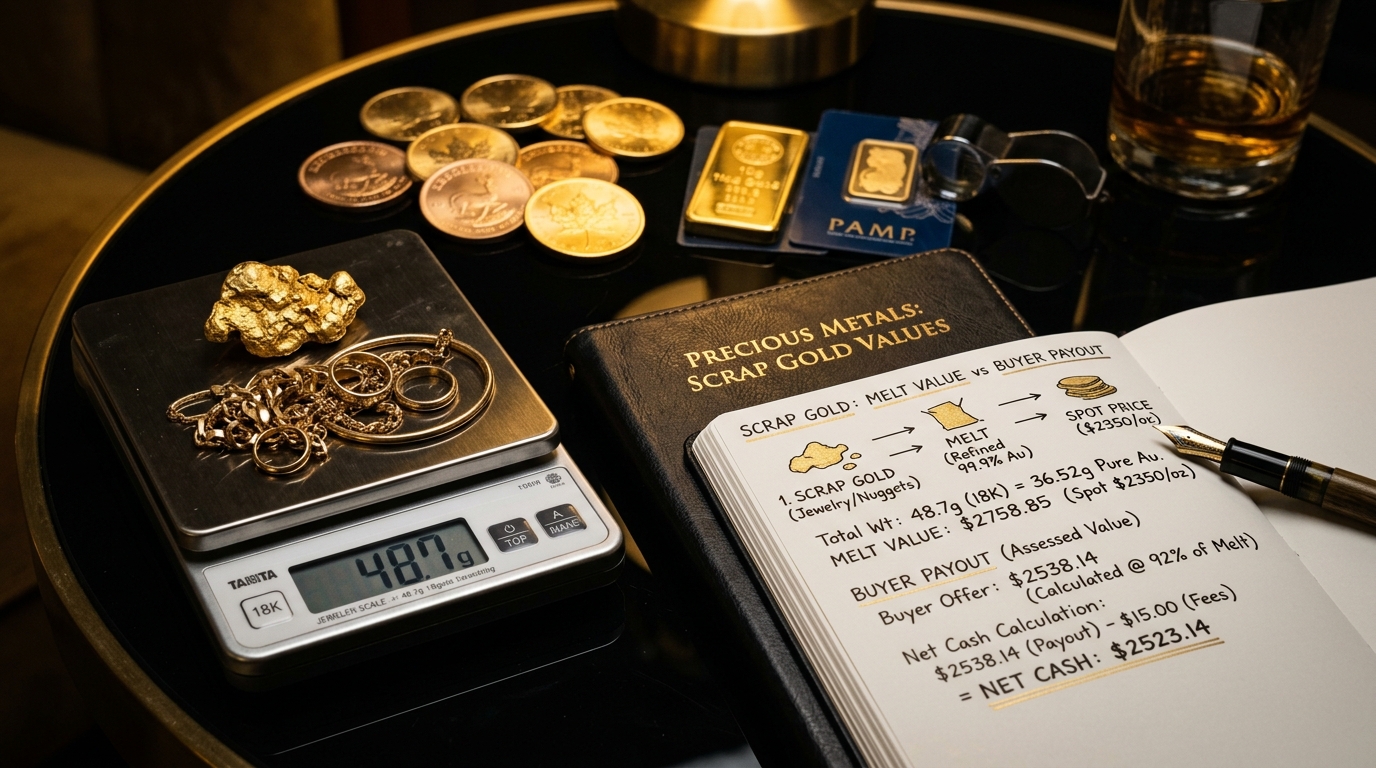
Theoretical melt value estimates contained gold at the current spot price, while buyer payout is the portion a buyer is prepared to pay under that buyer’s terms. Separately itemized fees can reduce the amount further, so estimated net cash should always be evaluated separately from melt value. Understanding melt value vs buyer payout protects sellers from confusing a theoretical market benchmark with actual take-home proceeds. For real-time calculations based on live market spot prices, use our Scrap Gold Calculator or check buyer spreads with the Scrap Gold Rates & Payout Calculator.
This guide explains how theoretical melt value is calculated, how buyers determine payout percentages, how explicit and embedded fees reduce net cash, and how to compare competing gold buyer offers on a true like-for-like basis.
What Is Theoretical Melt Value?
Theoretical melt value is the market value of the pure gold contained within an item, calculated by multiplying fine-gold mass by the live market spot price:
Fine-Gold Weight = Gross Weight × Purity Decimal
Theoretical Melt Value = Fine-Gold Weight × Current Spot Price
Melt value represents 100% of the intrinsic metal value on paper. It assumes the gold is already refined, pure, and traded on an institutional wholesale commodities exchange without transaction friction, logistics expenses, or commercial margins.
Because gold jewelry, coins, and scrap items are alloyed with base metals like silver, copper, and zinc, melting and refining are required before that metal can return to wholesale circulation. A theoretical melt value calculation does not account for those industrial steps. Therefore, theoretical melt value is a valuation benchmark, not a guaranteed cash offer. If you need to determine the underlying pure gold content from weight and karat stamps first, refer to our guide on How to Calculate Scrap Gold Value.
What Is a Buyer Payout?
A buyer payout is the actual dollar amount a commercial buyer offers to purchase a scrap gold lot before deducting separately itemized fees. It reflects the portion of theoretical melt value that the business is willing to pay after factoring in operating overhead, capital holding risk, and downstream refining margins:
Buyer Payout Before Separate Fees = Theoretical Melt Value × Payout Ratio
Commercial buyers do not pay 100% of melt value because they must re-refine the scrap metal, cover labor and testing expenses, insure shipping to an accredited refinery, and maintain a sustainable profit margin. The payout ratio typically varies based on lot size, item purity, business overhead, and wholesale access:
| Buyer Category | Typical Cost Structure | Margin Mechanism |
|---|---|---|
| Primary Refineries | High volume, automated assay facilities | Narrow margin embedded in settlement terms |
| Bullion Dealers | High volume, dedicated wholesale desks | Modest margin pegged closely to spot price |
| Local Coin & Jewelry Shops | Moderate volume, physical storefronts | Standard retail spread covering facility overhead |
| Pawnshops & Mail-In Buyers | Variable volume, extended holding periods | Broader spread reflecting holding costs and convenience |
No buyer category offers a single legally fixed payout percentage. Payout ratios are commercial terms established independently by each buyer.
How to Calculate Payout Percentage
The payout percentage—often called the payout ratio or offer percentage of melt—measures the proportion of theoretical melt value delivered by a buyer’s gross offer:
Payout Ratio = Buyer Payout Before Separate Fees ÷ Theoretical Melt Value
Offer Percentage of Melt = (Offer ÷ Theoretical Melt Value) × 100
To calculate the payout percentage:
- Determine the item’s fine-gold weight and calculate theoretical melt value using the live spot price.
- Identify the buyer’s gross offer before any separate transaction or refining fees.
- Divide the gross offer by the theoretical melt value and multiply by 100.
Worked Example: Suppose a lot of 14K scrap gold has a theoretical melt value of $1,000.00 at current spot prices. A buyer makes a gross offer of $900.00:
Payout Ratio = $900.00 ÷ $1,000.00 = 0.90
Offer Percentage of Melt = 0.90 × 100 = 90.0%
This 90.0% figure is a hypothetical benchmark. It demonstrates that the buyer’s gross offer represents 90% of the intrinsic market value of the gold. However, whether the seller takes home $900.00 depends on whether the transaction includes separately itemized deductions.
How Separately Itemized Fees Affect Net Cash
Separately itemized fees are explicit administrative, testing, or processing charges deducted from a buyer’s gross payout. When fees are itemized separately, the headline payout percentage no longer tells the entire financial story:
Estimated Net Cash = Estimated Payout Before Fees − Separately Itemized Fees
Common transaction deductions include:
- Assay and Testing Fees: Flat charges for x-ray fluorescence (XRF) spectrometer testing, ultrasonic analysis, or fire assay verification.
- Refining or Melting Fees: Charges applied per gross gram or troy ounce to cover furnace processing, fluxing, and chemical separation.
- Lot or Ticket Fees: Fixed administrative processing charges per transaction or purchase ticket.
- Inbound Shipping & Insurance: Flat or percentage deductions applied by mail-in gold purchasers to cover transit risk.
When comparing buyer offers, buyers typically structure their charges in one of two ways:
- All-Inclusive Embedded Margin: The buyer offers a lower headline payout percentage (for example, 88%), but waives all separate assay, melting, and processing fees.
- High Headline Payout with Separate Deductions: The buyer advertises a high payout percentage (for example, 92%), but deducts a $45.00 assay fee and a $15.00 administrative fee from the settlement slip.
Estimated net cash is the only metric that accounts for both pricing models accurately.
Melt Value vs Payout vs Net Cash
To evaluate any gold selling transaction clearly, divide the numbers into three distinct layers:
[Layer 1] Theoretical Melt Value = Fine-Gold Mass × Spot Price
           ↓
[Layer 2] Buyer Payout = Theoretical Melt Value × Payout Ratio (Gross Offer)
           ↓
[Layer 3] Estimated Net Cash = Buyer Payout − Separately Itemized Fees (Final Check)
The table below contrasts these three calculation layers:
| Dimension | Layer 1: Melt Value | Layer 2: Buyer Payout | Layer 3: Estimated Net Cash |
|---|---|---|---|
| Core Definition | Full spot value of contained gold | Buyer offer before separate fees | Final payment received by seller |
| Calculation Basis | Weight, purity, spot price | Melt value and payout percentage | Gross payout minus explicit fees |
| Commercial Role | Theoretical market benchmark | Negotiated wholesale/retail offer | Actual money deposited in bank |
| Guaranteed to Seller? | No | Only under quoted terms | Yes, finalized transaction amount |
| Impact of Small Lots | None (pure math) | Payout ratio may decrease | Flat fees heavily erode small lots |
A high headline payout percentage on a small lot can be completely erased by a flat assay fee. Always calculate Layer 3 before agreeing to a sale.
How to Compare Two Gold Buyer Offers
Evaluating two competing gold buyer offers requires normalizing both quotes to estimated net cash under the exact same spot-price basis:
- Request written quotes showing gross payout, stated purity basis, and an itemized breakdown of all applicable deductions.
- Verify that both buyers used the same spot-price benchmark timestamp, as gold prices fluctuate during active trading hours.
- Calculate the net cash for each offer by subtracting all itemized deductions from the gross payout.
Comparative Case Study: Consider a scrap jewelry lot with a verified theoretical melt value of $2,000.00:
| Calculation Component | Buyer A (High Headline Rate) | Buyer B (All-Inclusive Rate) |
|---|---|---|
| Theoretical Melt Value | $2,000.00 | $2,000.00 |
| Advertised Payout Ratio | 92.0% | 88.0% |
| Gross Offer Before Fees | $1,840.00 | $1,760.00 |
| Separate Assay Fee | −$50.00 | $0.00 |
| Separate Refining / Handling Fee | −$35.00 | $0.00 |
| Separate Payment Processing Fee | −$15.00 | $0.00 |
| Total Itemized Fees | $100.00 | $0.00 |
| Final Estimated Net Cash | $1,740.00 | $1,760.00 |
| Effective Net Yield on Melt | 87.0% | 88.0% |
In this scenario, Buyer A advertised a superior 92.0% payout, but separate fees deducted $100.00 from the total. Buyer B quoted a lower 88.0% payout with zero separate fees. Despite the lower advertised percentage, Buyer B delivered $20.00 more in net cash.
Why Two Buyers Can Produce Different Offers
When two reputable gold buyers examine the same scrap jewelry, their final offers can differ for several legitimate commercial reasons:
- Scale Calibration and Precision: Commercial scales must meet Class II or Class III legal-for-trade certification standards. Differences in tare weight or rounding precision can yield minor variations in recorded mass.
- Non-Gold Component Deductions: Gemstones, enamel, glass fills, spring clasps, and steel pins add gross weight but contain no recoverable gold. One buyer may estimate deductions visually, while another might remove stones or use specific gravity testing.
- Testing Technology: Acid scratch tests provide approximate purity bands. Electronic testers and XRF spectrometers deliver precise fineness readings. If a stamp is worn, an assay reading can alter the assessed karat fraction. If hallmarks are unclear, verify markings using a gold hallmark guide.
- Wholesale Logistics & Volume: Large-volume gold aggregators ship bulk consignments directly to primary refineries, allowing them to operate on tighter margins than independent pawnbrokers.
- Spot Price Timing: Gold trades continuously from Sunday evening to Friday afternoon. A quote given in the morning may not match an afternoon quote if market spot rates moved during the trading session.
When Melt Value Is Not the Best Valuation Method
Calculating theoretical melt value is the gold standard for damaged chains, broken rings, dental scrap, and worn jewelry. However, selling strictly for scrap melt value is disadvantageous when an item possesses value beyond its raw metal content:
1. Collector and Numismatic Gold Coins
Standard bullion coins trade very close to melt value with modest minting premiums. In contrast, rare numismatic coins, historic proofs, and high-grade collectible issues can command market prices several times higher than their contained gold weight. Melting a rare historic coin destroys its numismatic premium. Before treating any coin as scrap, inspect its collector value using the Gold Coin Value Calculator.
2. Designer Jewelry and Intact Estate Pieces
Fine jewelry from prestigious luxury houses (such as Cartier, Tiffany & Co., or Van Cleef & Arpels) carries significant brand equity, craftsmanship value, and retail secondary-market demand. Similarly, antique or vintage jewelry with historic provenance or intact natural gemstones is worth more to private collectors or auction houses than a refinery furnace. For pieces with significant stones or collectible designs, check our Gold Jewelry Value Calculator to understand net metal weight versus retail resale context.
Frequently Asked Questions
Is melt value what a gold buyer must pay?
No. Melt value is a theoretical calculation of raw contained gold at the full institutional spot price, whereas a buyer payout is a commercial offer that must cover overhead, refining costs, assay fees, and business margins.
What does percentage of melt mean?
Percentage of melt is the proportion of theoretical melt value that a buyer offers for scrap gold, calculated by dividing the buyer’s offer by the theoretical melt value and multiplying by 100.
Should I compare payout percentage or net cash?
Always compare net cash. A buyer advertising a high payout percentage may deduct separate assay, refining, or administrative fees that result in less take-home money than a lower headline percentage with zero fees.
Can fees be embedded in a lower payout?
Yes. Many gold buyers embed all testing, melting, and processing costs directly into a lower payout percentage, which eliminates separate itemized deduction charges from the final settlement receipt.
Can a collectible item be worth more than melt?
Yes. Rare numismatic coins, historic bullion, and signed designer jewelry often possess collector, artistic, or brand premiums that exceed their raw scrap melt value by a substantial margin.
Theoretical melt value establishes the baseline worth of raw gold, but estimated net cash determined by buyer payout ratios and itemized transaction fees represents the true financial return. Always evaluate offers by the total net cash received on a matching spot-price timestamp rather than headline payout percentages alone. When you are ready to check live market valuations across purities, consult the Scrap Gold Calculator to begin.